
Elephants in the jungle, not on show
Protection, not exploitation. The elephants live in the jungle with their mahouts. You walk out to meet them, quietly, at the distance the team sets.

Our elephants
Five elephants live around the camp, in two groups: one of three and one of two. One of them is still young.


The Nam Pouy jungle

Lao Elephant Home lies in the Nam Pouy National Protected Area, in Muang Thong, Sainyabuli Province, Laos.
The Nam Pouy protected area covers 191,200 hectares, nearly 1,900 km² of jungle and steep ridges: one of the largest in Laos.
It shelters the largest population of wild Asian elephants left in Laos, 50 to 60 according to WWF (2018), as well as the white-handed gibbon. Since October 2024, it has been an ASEAN Heritage Park, and 32 of its species (15 mammals, 10 birds, 7 reptiles) are priorities for protection.
The elephants live free in the jungle around the camp. They follow roughly the same circuit every 7 to 10 days and stop at the same water points; the mahouts know where they are.
An easy trek, with hardly any climbing: just watch where you step. Unexploded ordnance remains a hazard across Laos: stay on the paths.
The community: the camp and its village
The mahouts live at the camp, as close as possible to their elephants, and so does the team.
A regenerative loop that supports the neighbouring village too: the meat comes from the villagers, and most of the vegetables from local farmers we all know personally. The camp also grows some of its own food, including a little rice. They help us, and we help them.
The camp was built in 2023, in four months, with the help of the villagers. Your visit supports the people who keep the camp alive: mahouts, guides, cooks and weavers.
The camp, the river, the jungle
An illustrated map, not to scale. We never mark where the elephants are: they go where they please.
-
Paklay
The meeting point is Paklay, Sainyabuli Province. The team picks you up in Paklay and drives you back there at the end; this is included.
-
The track
From Paklay, it is about an hour and a half by 4×4 to Muang Thong, then straight on to the camp.
-
Muang Thong
The neighbouring village, the last one before the camp.
-
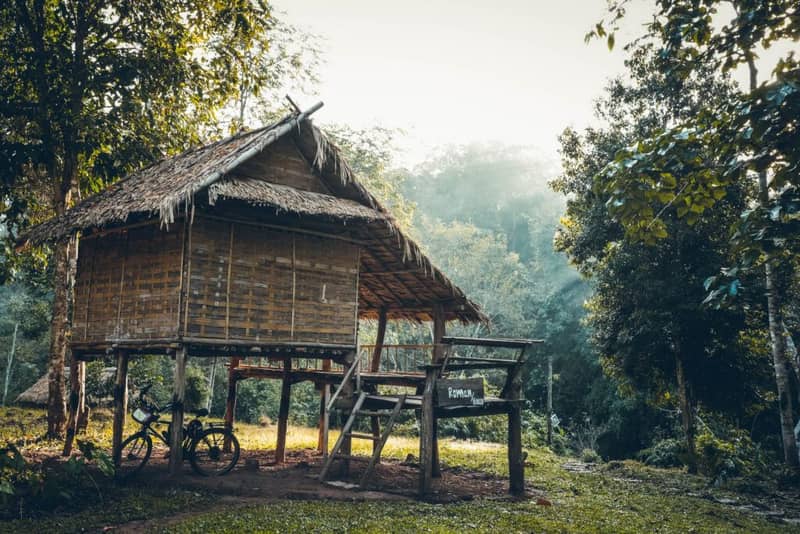
The camp
You sleep at the camp in a bamboo bungalow, for two or on your own, under a mosquito net: the jungle does the rest. The bungalows were built with the villagers, from bamboo grown in the province.
-
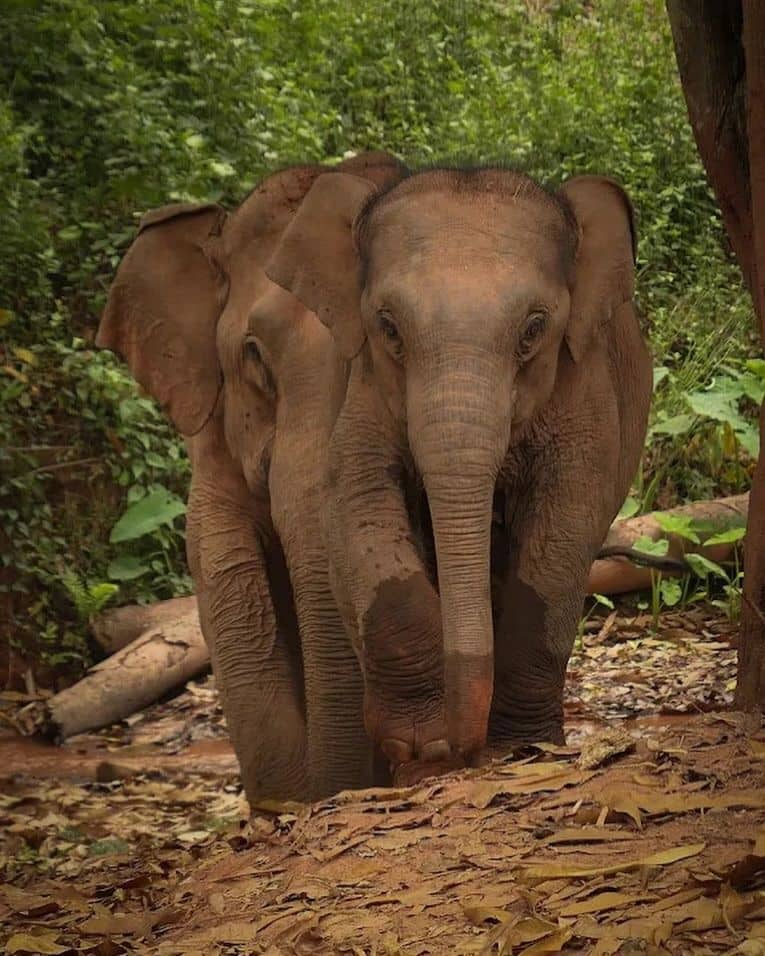
The jungle

What your visit makes possible
Your visit funds life at the camp: wages, running costs and the camp’s growth.
Every contribution, from every volunteer and every traveller, helps us give the mahouts and their elephants a little more freedom.

The mahouts
Each mahout receives a regular allowance and has a house at the camp, close to his elephant. Your visit pays the wages of the mahouts and the team.
The volunteers
Many volunteers help us day to day, at the camp and remotely, with the website, communication and much more.
The camp lives mostly on recommendation: most travellers come because someone told them about it.
Being a good guest
Elephants are powerful animals. A few simple rules keep everyone safe, and the team shares them with you on arrival.
- Always follow the mahout’s and the guide’s instructions, without delay.
- Keep the distance the guide shows you; never approach alone.
- Let the elephant come to you: never block its path, stand between a mother and her calf, or walk behind it.
- Keep your voice low. No flash.
- A drone? Ask us before you come: the camp lies in a protected national park, and the elephants are not used to them.
- Children stay within arm’s reach of an adult.
- Ask villagers and members of the team before you photograph them.
Questions visitors ask
What is a mahout?
A mahout is the person who looks after an elephant, every day and often for a lifetime. In Laos, an elephant often stays in the same family of mahouts for generations.
Who do the elephants belong to?
The elephants belong to their mahouts and their families.
Where do the elephants come from?
They once worked in logging and carried tourists. Today they live free, and nobody rides them any more.
Can I ride, bathe, feed or touch an elephant?
No elephant riding. No bathing with the elephants. The elephants find their own food in the jungle: here, you watch them eat, you do not feed them.
Will I definitely see them?
The mahouts know the elephants’ routes and water points and lead you there, at the elephants’ pace. And elephants make a lot of noise in the jungle: you hear them before you see them.
How long is the walk?
The walk lasts two to three hours, at the elephants’ pace, guided by the mahouts.
Can I fly a drone or take photos?
Photos are welcome, without flash. Drones only with our permission, requested before you come: see the rules above.

Come and walk with them
Small groups only: send your request early.