
A few days at the elephants’ pace
The elephants live in the jungle with their mahouts. You walk to them; the rest of the time, you live at the camp, with the people who keep it alive.

Why this camp exists
Everything here starts with the mahouts. A mahout is the person who looks after an elephant, every day and often for a lifetime. In Laos, an elephant often stays in the same family of mahouts for generations.
Yesterday
They once worked in logging and carried tourists. Today they live free, and nobody rides them any more.
The mahouts’ dilemma
The mahouts have no wish to put their elephants to work: they would much rather know they are free in the jungle. But they need an income, and work is scarce in the region. Without one, many have reluctantly had to put their elephant back to work.
What the camp changes
Each mahout receives a regular allowance and has a house at the camp, close to his elephant. Your visit pays the wages of the mahouts and the team. The mahout no longer needs to put his elephant to work: he can devote himself to caring for it.
Your contribution
Every contribution, from every volunteer and every traveller, helps us give the mahouts and their elephants a little more freedom. We hope to see the camp grow, and to save as many elephants as we can.
A day at the camp
No two days are alike: the pace follows the elephants, the weather and how you feel. Over the course of your stay, you will find:
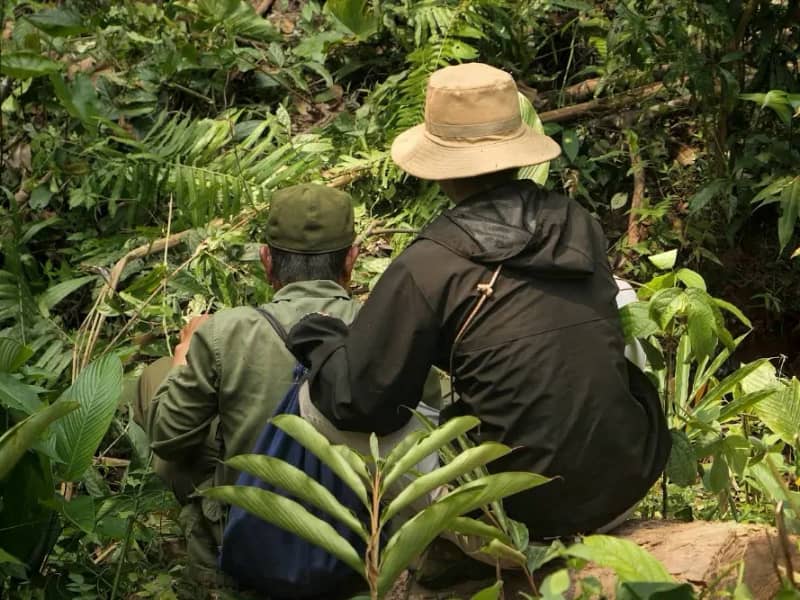
The walk to the elephants
A walk through the jungle takes you to the elephants, to watch them where they live. The walk lasts two to three hours, at the elephants’ pace, guided by the mahouts.
The elephants live free in the jungle around the camp. They follow roughly the same circuit every 7 to 10 days and stop at the same water points; the mahouts know where they are.
The walk is never the same: where you go, and when, depends on where the elephants are that day.
Camp life
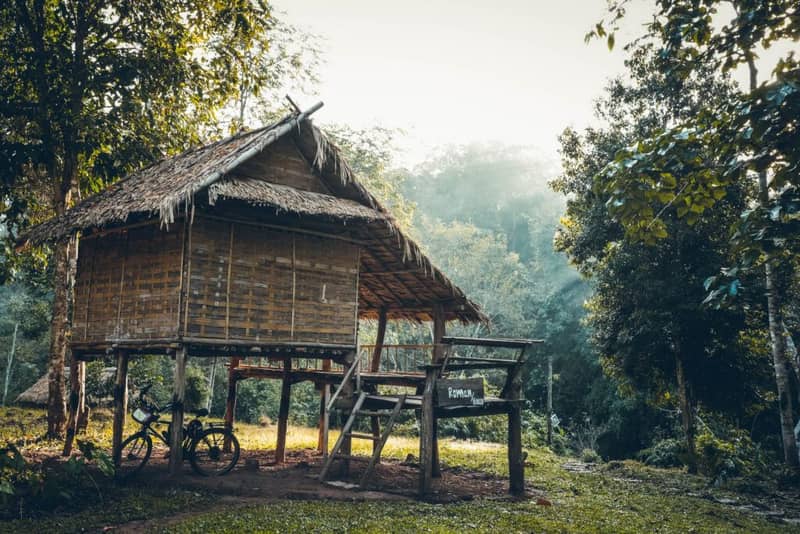
The camp lies away from the village, surrounded by nature. The rest of the day is varied, and you do whatever you feel like:
- A walk in the jungle
- A Lao cooking class with the villagers
- A baci blessing ceremony
- Meeting the people of the camp and talking with the villagers
A visit to a family distillery that makes lao-lao, the local rice spirit. The woman who runs it also grows cassava.
Also on offer, with villagers and in keeping with local custom: bamboo building and a cotton-weaving workshop.
The evening
Campfire evenings.


Mahouts, guides, cooks and weavers: the camp is the people who run it.

« Now our relationship is calmer. »


The people who make the camp
Roles, everyday tasks and days, not numbers.
The mahouts
Every day in the jungle
The elephants belong to their mahouts and their families.
The guides and the team
The walk, and the camp
They take you on foot to the elephants, tell you about the jungle, and keep the camp running day after day.
The kitchen
Every meal
All meals are included; let us know about any allergies or dietary needs (vegetarian, for example) before you come.
The weavers
At the loom
Lao weaving with women weavers from the area: you weave your own piece of cloth.
The volunteers
Here and from afar
Many volunteers help us day to day, at the camp and remotely, with the website, communication and much more.
The camp was built in 2023, in four months, with the help of the villagers. Your visit supports the people who keep the camp alive: mahouts, guides, cooks and weavers.
Simple comfort, deep in the jungle
Here, the air conditioning is the evening breeze coming down from the jungle, and your alarm clock is the birdsong.
- The bungalows were built with the villagers, from bamboo grown in the province. The mahouts live at the camp, as close as possible to their elephants, and so does the team.
- You sleep at the camp in a bamboo bungalow, for two or on your own, under a mosquito net: the jungle does the rest.
- Small solar panels provide light in the evening and enough power to charge a phone. Phone signal? A four-minute walk away: a good excuse to switch off.
- The toilets are standard; only the shower is different: a bucket of fresh water, which, in this heat, you soon start to look forward to.
Who it is for
Individuals, couples, families
Send a request with your dates and group: the team replies with availability.
Travel agencies
Offer your clients an elephant experience with no riding, in the jungle and at the camp.
Schools and NGOs
Educational trips and projects around elephants, the jungle and camp life.
What this experience is, and what it is not
It is
- Time to walk, watch and listen
- A simple life at the camp, shared with the people who live there
- Time to reconnect with nature, and to recharge
- A real immersion, alongside local people: time to talk and to learn from each other
- Learning to watch elephants in their natural habitat
- Support that goes straight to the camp and its mahouts
- A camp for small groups
It is not
- A hotel: here, the luxury is the silence of the jungle
- A zoo: the elephants come and go as they please

Does this sound like you?
Choose an experience and give us your dates: the team will confirm by email.